


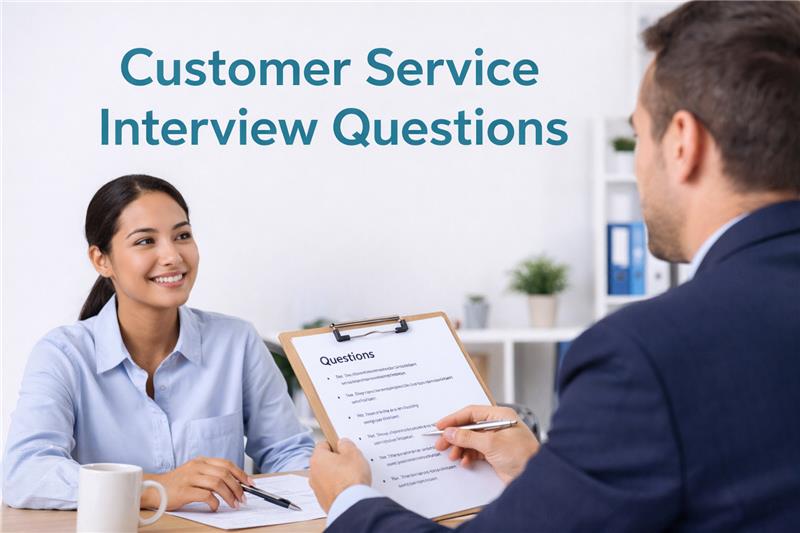
🤔 Are you preparing for a customer service job interview? This one is for you.👍
Whether you are a fresher stepping into your first job or someone looking to switch careers, customer service roles are one of the most in-demand jobs in India today. Companies across every sector, from e-commerce to banking, from BPOs to retail are actively hiring for these roles.
But here is the thing: a lot of candidates lose out not because they lack skills, but because they are not prepared for the interview. They do not know what questions to expect or how to answer them confidently.
This blog covers the most commonly asked customer service interview questions along with smart sample answers and tips to crack the interview. By the end of this blog, you will be fully ready to walk into your next interview with confidence.
What Is A Customer Service Interview?
A customer service interview is a job interview where the hiring manager tests your ability to handle customers, solve problems, communicate clearly, and stay calm under pressure. These interviews usually have a mix of basic HR questions, situational questions, and role-specific questions.
Must-Know Customer Service Interview Questions


Here are the most commonly asked questions in customer service interviews, along with sample answers that you can personalize and use.
1. Tell me about yourself
Why they ask this question? To understand your background, communication style, and how well you present yourself.
| Sample Answer: “My name is Ritu Sharma. I completed my graduation in Commerce from Delhi University. I have always been good at communication and enjoy helping people solve their problems. I have done a 6-month internship where I handled customer queries over chat and phone. I am now looking for a full-time role where I can grow in the customer service field.” |
2. Why do you want to work in customer service?
Why they ask this question? To check if you are genuinely interested in the job or just applying for the sake of it.
| Sample Answer: “I enjoy talking to people and finding solutions to their problems. Customer service gives me the chance to directly make someone’s experience better, and that feels very satisfying. I am also excited about the growth opportunities this field offers.” |
This is one of the first questions most interviewers ask, so going in with a prepared answer matters. A deeper look at why you want to work in customer service can help you frame a more personalized and confident response.
3. How would you handle an angry customer?
Why they ask this question? This is one of the most important situational questions. They want to know if you can stay calm and professional under pressure.
| Sample Answer: “First, I would let the customer speak and listen carefully without interrupting. Then I would apologies for the inconvenience, even if it was not my fault, because the customer’s frustration needs to be acknowledged. After that, I would try to understand the exact problem and offer the best possible solution. If the issue was beyond my control, I would escalate it to my supervisor and keep the customer informed at every step.” |
4. What does good customer service mean to you?
| Sample Answer: “Good customer service means making the customer feel heard, valued, and helped. It is not just about solving the problem, but about how you make the person feel during the process. A customer who feels respected is more likely to come back.” |
5. Can you describe a time you went above and beyond for a customer?
| Sample Answer: “During my internship, a customer called very upset because their order had not arrived. Even though it was an issue with the courier, I personally tracked the package, kept the customer updated every 2 hours, and ensured it was delivered the same day by coordinating with the delivery team. The customer was very grateful and gave us a 5-star rating.” |
6. How do you handle multiple customers at the same time?
| Sample Answer: “I priorities based on urgency. If a customer has a complaint that needs immediate action, I handle that first. For less urgent queries, I let the customer know I will get back to them shortly and make sure I follow through. I also use ticketing tools or chat platforms to keep track of all conversations so nothing falls through the cracks.” |
7. What would you do if you did not know the answer to a customer’s question?
| Sample Answer: “I would be honest with the customer and tell them I need a moment to find the correct answer. I would check with my team leader or the knowledge base available to me. I would never give wrong information just to seem helpful. Honesty and accuracy are very important in customer service.” |
8. How would you handle a situation where a customer is asking for something against company policy?
| Sample Answer: “I would empathize with the customer and explain the policy clearly and politely. I would try to offer an alternative that is within the policy. If the customer is still unhappy, I would escalate it to my supervisor so they can take a final call. My goal would always be to find a solution that satisfies the customer without breaking company rules.” |
9. Where do you see yourself in 2-3 years?
| Sample Answer: “I see myself growing within the customer service field, perhaps as a team leader or a senior executive. I want to develop my skills in communication, problem-solving, and people management. I believe this role is a great starting point for that journey.” |
10. What are your strengths and weaknesses?
| Sample Answer: “My biggest strength is my patience. I stay calm even when customers are upset, and I listen carefully before responding. As for my weakness, I sometimes spend too much time trying to fully solve a problem instead of escalating it. But I am actively working on recognizing when to escalate quickly so the customer gets help faster.” |
Skills You Need For Customer Service Jobs
Before walking into an interview, make sure you can demonstrate these key skills:
- Communication – Can you explain things clearly and politely?
- Empathy – Do you understand how the customer feels?
- Problem-solving – Can you think on your feet and find solutions?
- Patience – Can you stay calm when a customer is difficult?
- Product knowledge – Do you understand what the company offers?
- Multitasking – Can you handle several customers or tasks at once?
Strong communication is the backbone of every customer service role. Understanding the communication cycle and its elements can help you become a more effective communicator both with customers and within your team.
Tips To Crack Your Customer Service Interview
1. Research The Company: Know what the company does and who their customers are. This shows you are serious about the role. A question like why do you want to join our company is almost always asked, thus you must prepare a sharp answer for it.
2. Practice Your Answers Out Loud: Reading answers is not enough. Speak them aloud in front of a mirror or with a friend.
3. Use Real Examples: Wherever possible, use real examples from your past experience, even part-time or internship work counts.
4. Dress Appropriately: For customer service roles, neat and professional attire makes a good first impression.
5. Ask Good Questions: At the end of the interview, ask something like: “What does success look like in this role in the first 3 months?” Because knowing the right questions to ask in an interview can leave a strong impression on the interviewer.
6. Keep Your Resume Updated: Make sure your resume highlights relevant experience before the interview.
Career Growth In Customer Service
Many people think customer service is just an entry-level job. But the truth is, it is one of the fastest career growth paths in India. Here is a typical path:
Customer Service Executive → Senior Executive → Team Leader → Assistant Manager → Manager
With experience, many professionals also move into Sales, HR, Operations or Business Development. A large number of customer service roles in India are based in the BPO sector. If you are exploring that path, understanding what is BPO and its job functions will give you a clear picture of the industry and what to expect.
If you are just starting out and applying for your first customer service role, a good cover letter for a job can make your application stand out before you even reach the interview stage.
Conclusion
Customer service is one of the most rewarding career paths you can choose. It builds your communication skills, teaches you how to handle pressure, and opens doors to many other roles in the future.
The key to cracking a customer service interview is simple: be genuine, be prepared, and show that you genuinely care about people. Use the sample answers in this blog as a guide, personalize them with your own experiences, and walk in with confidence.
Ready to find your next customer service job? Apply on Job Hai and connect directly with HRs today.
FAQs
Q1. What are the most common customer service interview questions?
The most common questions include: Tell me about yourself, How do you handle an angry customer, What does good customer service mean to you, and where do you see yourself in the future. This blog covers all of them with sample answers above.
Q2. How do I introduce myself in a customer service interview?
Keep it short and relevant. Mention your name, education, any work or internship experience, and why you are interested in customer service. End with why you are excited about this specific role.
Q3. What are the top skills needed for customer service jobs?
The top skills are communication, empathy, patience, problem-solving, multitasking, and product knowledge. Being comfortable using computers and basic software tools is also important.
Q4. How do I answer “Why should we hire you?” in a customer service interview?
Focus on your strengths that match the job. For example: “You should hire me because I am a patient listener, I stay calm under pressure, and I am genuinely committed to making customers happy. I also learn quickly and adapt well to new processes.”
Q5. What should I wear to a customer service interview?
Dress neatly and professionally. For most customer service roles, formals or smart casuals work well. Avoid overly casual clothes unless the company culture is very informal.
Q6. How do I answer situational questions in a customer service interview?
Use the STAR method: Situation, Task, Action, Result. Describe the situation, explain what your role was, what you did, and what the result was. This gives a structured and clear answer.
Q7. Is experience important for a customer service job interview?
Not always. Many companies hire freshers for customer service roles. You just need good communication skills, a positive attitude, and willingness to learn. Part-time work, internships, or even volunteering counts.
Q8. What questions are asked in a telecaller interview?
Telecaller interviews focus on phone communication, handling rejection, meeting call targets, and building rapport quickly. For a complete list with answers, go through telecaller interview questions for freshers.
Q9. How should I prepare for a customer service interview in one day?
Practice common questions in this blog, research the company’s products and customers, and keep your resume and documents ready. You can also prepare for tricky questions like why did you leave your last job. Interviewers in customer service roles ask this very often.
Q10. What questions should I ask the interviewer at the end of a customer service interview?
Good questions to ask: “What does the training process look like? What are the daily responsibilities of this role? What qualities do your top-performing customer service employees have?” These show that you are serious and thoughtful about the opportunity.






 Facebook
 Instagram
 Twitter




