


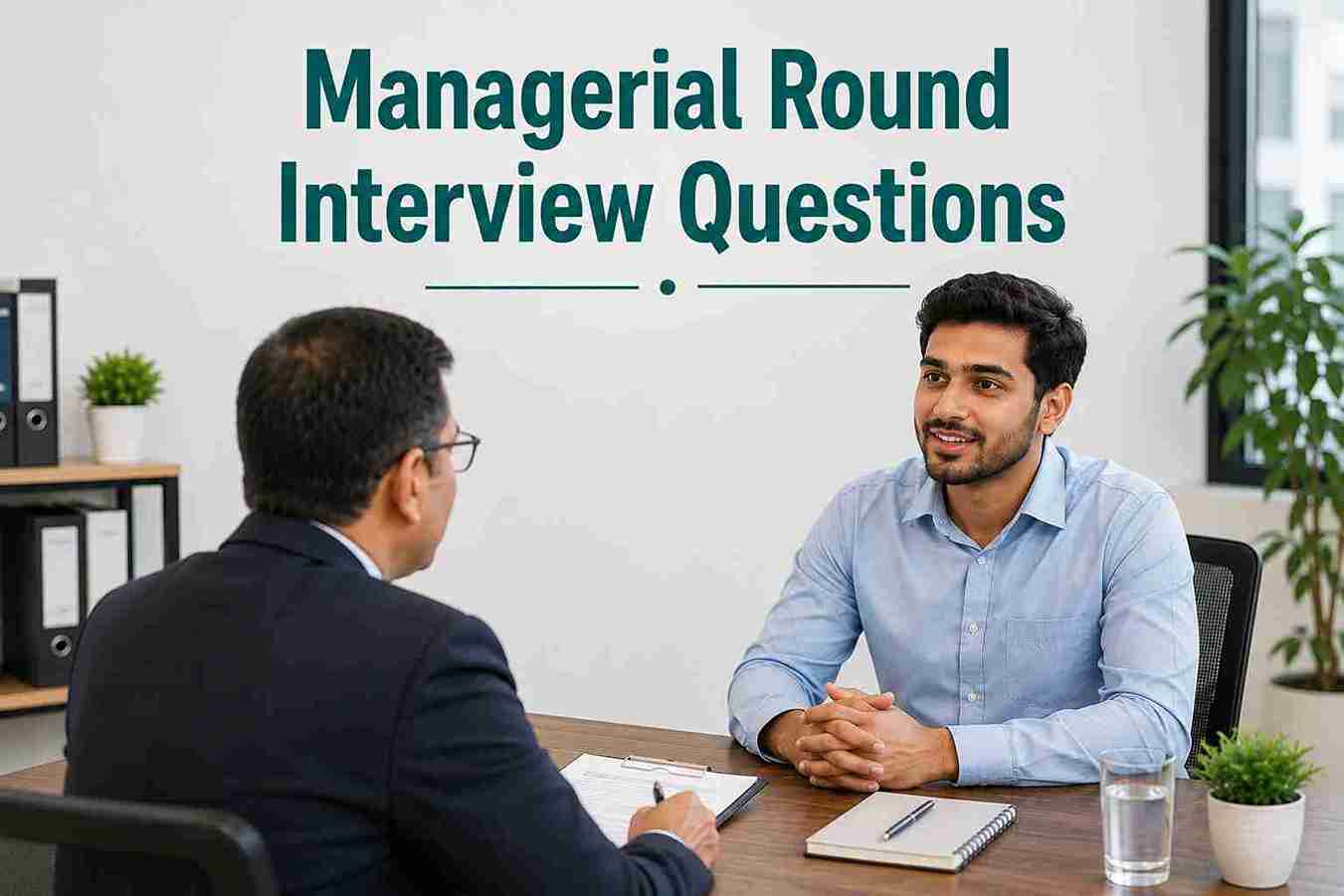
Most hiring processes in India move a candidate through several different rounds before an offer is made. It starts with a screening call, a technical or skills round, a managerial round and finally an HR discussion, and each one is testing something different. Where a technical round checks what you know, an HR round checks whether you will accept the offer. Between these two sits the managerial round, which checks whether the person hiring you would actually want you on their team. That is what changes how you should prepare for it.
For experienced professionals as well as freshers stepping into leadership-track roles, understanding managerial round interview questions in advance significantly improves performance. This blog covers the most commonly asked managerial round interview questions, how to structure your answers, what interviewers are really assessing and how to prepare properly for the final stage of hiring.
What Is A Managerial Round Interview?
A managerial round interview is conducted by a reporting manager, department head or senior leader. The objective is to assess whether the candidate can:
- Handle responsibility and pressure
- Work independently with minimal supervision
- Collaborate across teams
- Solve practical workplace problems
- Align with business goals
Unlike the earlier rounds, this stage focuses less on textbook answers and more on judgment, maturity and ownership. This round is very important especially in mid sized firms and IT services organisations, where the manager decides your reporting structure and initial project allocation. Thus make sure to make a good first impression here because it tends to stick.
Why Is The Managerial Round So Important?
Recruiters may shortlist a profile, but hiring managers make the final decision. This round often determines:
- Role clarity and expectation alignment
- Salary approval and offer confirmation
- Team fit and long-term growth potential
- Leadership readiness
Even highly skilled professionals can lose opportunities if they fail to demonstrate strategic thinking or professional stability in this round.
Interview Questions And How To Answer Them
Below are the most frequently asked managerial round interview questions, along with practical guidance on how to approach/answer them.
Q1. Tell me about yourself.
This question sets the tone for the entire discussion.
How to structure the answer:
- Brief professional background
- Key achievements relevant to the role
- Current responsibilities
- Future career direction
Keep it structured and concise. Avoid personal details unrelated to work.
Read: How To Answer “Tell Me About Yourself”?
Q2. Why should we hire you for this position?
The interviewer is evaluating value addition.
Answer strategy:
- Highlight measurable achievements
- Connect skills to company goals
- Show problem-solving capability
- Demonstrate ownership mindset
Avoid generic responses. Focus on impact-driven examples. For a detailed explanation, read How To Answer “Why Should We Hire You”?
Q3. Describe a challenging situation at work and how you handled it.
This assesses problem-solving and emotional intelligence.
Use the STAR method:
- Situation
- Task
- Action
- Result
Managers look for calm decision-making and accountability rather than blame.
Q4. How do you handle conflict within your team?
Leadership maturity is tested here. Strong answers include:
- Active listening
- Neutral analysis
- Data-driven resolution
- Fair communication
- Follow-up actions
Conflict management is a key competency in managerial round interviews.
Q5. What is your leadership style?
Candidates applying for senior or supervisory roles must answer clearly. Common leadership approaches include:
- Collaborative leadership
- Situational leadership
- Results-oriented leadership
- Coaching-based leadership
Explain your leadership style with a real example instead of just naming a theory.
Q6. Why do you want to leave your current job?
This question checks professionalism. Guidelines:
- Avoid negativity
- Focus on growth
- Mention new challenges
- Align answer with long-term goals
Negative remarks about current employers can create doubt.
Q7. How do you prioritize tasks under pressure?
Time management is crucial in managerial roles. Explain:
- Task segmentation
- Impact-based prioritization
- Deadline planning
- Delegation where required
Demonstrating structured thinking builds credibility.
Q8. Where do you see yourself in five years?
Managers evaluate ambition and stability. An effective answer:
- Shows growth mindset
- Aligns with industry progression
- Reflects leadership aspiration
- Demonstrates commitment
Avoid unrealistic titles or vague answers.
Q9. How do you handle failure?
Managers value resilience. Answer framework:
- Accept responsibility
- Identify learning
- Explain corrective action
- Show improvement
Professional maturity matters more than perfection.
Q10. How do you motivate your team?
Even non-managerial candidates may face this question. Include:
- Clear goal setting
- Recognition systems
- Transparent communication
- Skill development support
Motivation in management is tied to performance outcomes.
Common Behavioral Questions In Managerial Interview
Behavioral questions dominate managerial interviews. These questions begin with phrases like:
- “Tell me about a time when…”
- “Give an example of…”
- “Describe a situation where…”
Examples include:
- Tell me about a time you handled a difficult client.
- Describe a time you disagreed with your manager.
- Share an instance when you exceeded performance targets.
- Explain a time you managed multiple deadlines.
These questions test practical experience rather than theoretical knowledge.
Situational Questions In Managerial Interview
Situational questions assess hypothetical judgment. Examples:
- What would you do if your team member consistently misses deadlines?
- How would you manage a sudden project delay?
- What would you do if two senior team members disagreed strongly?
Focus on logic, fairness, communication and business impact.
Skills Check In A Managerial Round Interview
Understanding evaluation parameters helps structure answers better.
1. Decision-Making Ability: Managers expect clear reasoning supported by data.
2. Leadership Potential: Even individual contributors are assessed for future leadership capacity.
3. Communication Skills: Clarity, structure and confidence matter.
4. Accountability: Taking ownership builds trust.
5. Strategic Thinking: Connecting daily tasks to larger organizational objectives.
6. Adaptability: Business environments change rapidly, flexibility is essential.
How To Prepare For A Managerial Round Interview?
Preparation goes beyond rehearsing answers.
- Study The Job Description Deeply: Align skills and achievements with role expectations
- Research The Company: Understand industry position, competitors, and recent developments
- Prepare Achievement Stories: Keep at least 5-6 strong examples ready
- Practice Structured Communication: Avoid rambling. Keep responses focused
- Review Performance Metrics: Numbers strengthen credibility
- Prepare Intelligent Questions: Ask about team structure, performance metrics and growth opportunities
Mistakes To Avoid In A Managerial Round Interview
- Speaking negatively about previous employers
- Giving generic, memorized answers
- Overconfidence or arrogance
- Lack of data to support achievements
- Inability to explain gaps or transitions clearly
- Poor body language
Conclusion
The managerial round interview is not about perfect answers. It is about demonstrating clarity, ownership, leadership potential and alignment with business goals. Structured preparation, real examples and calm communication create a strong impact.
Every managerial interview question is an opportunity to show how professional experience translates into business value. Candidates who focus on measurable achievements, problem-solving ability, and team collaboration consistently stand out. Thorough preparation, self-awareness and strategic storytelling are the keys to succeeding in managerial round interviews and securing the final offer.
FAQs
1. What is the main purpose of a managerial round interview?
It evaluates leadership ability, decision-making skills, cultural alignment, and long-term potential within the organization.
2. Is the managerial round harder than technical rounds?
It can be more challenging because it assesses mindset, maturity and real-world application rather than theoretical knowledge.
3. How long does a managerial round interview usually last?
Typically 30-60 minutes, depending on the role and company.
4. Can freshers clear a managerial round interview?
Yes, by showcasing initiative, accountability and leadership in academic or internship experiences.
5. How should salary expectations be handled in this round?
Provide a realistic range supported by market research and current compensation.
6. What if the interviewer asks unexpected questions?
Stay calm, think logically, and structure the response clearly.
7. Are behavioral questions important in managerial interviews?
Yes, they form a major portion of the discussion.
8. How important is body language in a managerial interview?
Very important. Confidence and composure influence perception.
9. Should technical details be discussed again?
Only at a high level unless asked specifically.
10. How to reduce nervousness before the managerial round?
Preparation, mock interviews and structured thinking significantly improve confidence.




 Facebook
 Instagram
 Twitter




