


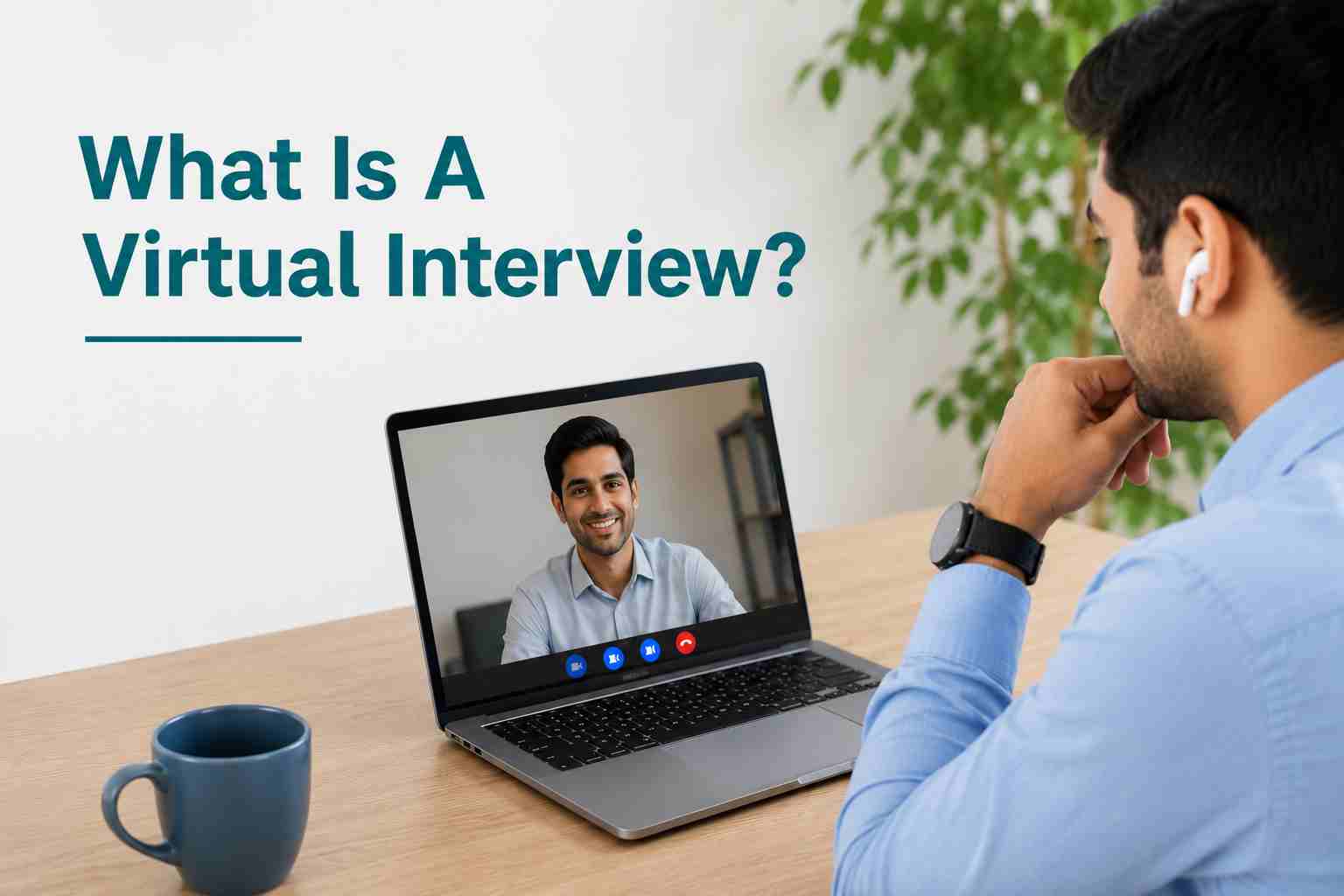
Not too long ago, the word “interview” meant one thing. Dressing up, commuting to an office and sitting across a table from a hiring manager. Well, that experience still exists. But alongside it, a completely different kind of interview has taken over and that is the virtual interview.
Today, virtual interviews are the norm across companies of all sizes in India. From early-stage startups to large MNCs, from entry-level roles to senior leadership positions, the first interaction between a candidate and a company almost always happens online.
But what exactly is a virtual interview? How is it different from a regular interview? And what are the different forms it can take?
Keep reading this guide and you will have all the answers.
What Is A Virtual Interview?
A virtual interview is a job interview conducted remotely using technology, typically through a video call, phone call, or an online assessment platform, rather than in person at a physical location.
Instead of meeting the interviewer face to face in an office, the candidate connects digitally from wherever they are. The conversation, questions and evaluation process remain largely the same as a traditional interview. What changes is the medium through which it happens.
Virtual interviews became widely adopted during the pandemic and have since become a permanent and preferred part of the hiring process for many organisations. They are used across every stage of recruitment, from the first screening call to the final round with senior leadership.
In simple terms, a virtual interview is what happens when the interview room moves from an office to a screen.
🔗Read: First Round Vs Final Round Interview
Virtual Interview Vs In-Person Interview: Key Difference
Both virtual and in-person interviews serve the same purpose of helping an employer evaluate whether a candidate is the right fit for a role. But they differ in several important ways, such as:
1) Location
An in-person interview happens at the employer’s office or a designated location. Whereas, a virtual interview happens wherever the candidate and interviewer choose to connect from, typically their respective homes or offices.
2) Format
In-person interviews rely on physical presence, body language and the natural energy of a room. Virtual interviews rely on a stable internet connection, a functioning camera and microphone, and the ability to communicate effectively through a screen.
3) Logistics
In-person interviews require travel, punctuality and physical preparation. Virtual interviews require technical preparation such as testing your device, internet connection, lighting, and background before the call.
4) Comfort And Accessibility
Virtual interviews remove geographical barriers. A candidate in Chennai can interview with a company in Mumbai without leaving their city. This makes the process more accessible and efficient for both sides.
🔗Read: How To Dress Up For An Interview
Types Of Virtual Interviews
Virtual interviews are not one-size-fits-all. Depending on the company, the role, and the stage of the hiring process, you may encounter any of the following formats:
Video Interview
This is the most common type of virtual interview. It is conducted over a video call platform like Zoom, Google Meet, Microsoft Teams, or Webex. The candidate and interviewer can see and hear each other in real time, making it the closest experience to an in-person interview.
Video interviews can be one-on-one, with a panel of interviewers, or even with multiple candidates present simultaneously in some group discussion formats.
Phone Interview
A phone interview is conducted entirely over a voice call with no video component. It is typically used as an early-stage screening tool to assess a candidate’s communication skills, basic qualifications, and interest in the role before investing time in a full video interview.
Phone interviews are shorter, usually lasting 15 to 30 minutes, and are often the very first interaction a candidate has with a company after submitting their application.
Pre-Recorded Video Interview
In a pre-recorded video interview, the candidate is presented with a set of questions on screen and asked to record their responses within a given time limit. There is no live interviewer on the other end and the responses are reviewed by the hiring team later at their convenience.
This format is increasingly used by large companies handling high volumes of applications, as it allows them to screen many candidates efficiently before moving to live interview rounds.
Self-Paced Video Interview
Similar to a pre-recorded video interview, a self-paced video interview allows candidates to respond to questions at their own pace within a set deadline, rather than in a scheduled, real-time session. The flexibility this offers is particularly useful when candidates and interviewers are in different time zones.
Technical Or Online Assessment Interview
For roles in technology, finance, data analytics and other specialised fields, companies often conduct virtual technical assessments alongside or in place of a traditional interview. These are conducted through online platforms and test domain-specific skills through coding challenges, case studies, or analytical exercises.
Group Virtual Interview
Some companies conduct virtual group discussions or group interviews where multiple candidates are brought together in a video call and evaluated on their communication, collaboration, and leadership skills. This is common in campus hiring and management trainee programmes.
Why Do Companies Conduct Virtual Interviews?
Virtual interviews have become the default for most companies in India not just out of convenience but because they offer genuine advantages for both employers and candidates.
- They save time: Scheduling and conducting virtual interviews is significantly faster than coordinating in-person meetings. This speeds up the overall hiring process and helps companies fill roles faster.
- They remove geographical barriers: Companies can interview candidates from across India or even internationally without requiring anyone to travel. This expands the talent pool significantly.
- They are cost effective: For both companies and candidates, virtual interviews eliminate the costs associated with travel, venue, and logistics.
- They offer flexibility: Virtual interviews can be scheduled with greater flexibility, making it easier to find a time that works for both the candidate and the interviewer.
- They support high-volume hiring: Pre-recorded and asynchronous formats allow companies to screen large numbers of candidates efficiently, which is particularly valuable during campus hiring seasons or large-scale recruitment drives.
Importance Of Virtual Interviews For Candidates
Virtual interviews are not just convenient for employers. They offer real advantages for candidates too.
- No travel required: You can attend a virtual interview from anywhere, whether it is your home, a quiet cafe, or your current workplace. This saves time, money, and the stress of commuting.
- More comfort: Being in a familiar environment can reduce interview anxiety. Many candidates find they perform better in virtual interviews than in-person ones because they feel more at ease.
- Access to more opportunities: Virtual interviews allow you to apply for and interview with companies across India, not just those in your city. This significantly widens your career options.
- Time to prepare: For pre-recorded formats, you get the questions in advance and can record your responses thoughtfully, which gives you more time to present your best answers.
- A level playing field: Everyone interviews from their own environment, which removes some of the first-impression bias that can sometimes influence in-person interviews.
🔗Read: How To Prepare For Virtual Interviews?
Virtual Interview Platforms Commonly Used
Here are the most widely used platforms for virtual interviews across Indian companies:
- Zoom – One of the most popular video conferencing tools used for interviews across all industries
- Google Meet – Widely used by companies that operate on Google Workspace
- Microsoft Teams – Common in large enterprises and MNCs
- Webex – Used by larger organisations, particularly in IT and consulting
Most platforms work directly from a browser, though downloading the app in advance is always recommended for a smoother experience.
Conclusion
Virtual interviews are not a temporary workaround. They are a permanent and growing part of how hiring works in India today. Understanding what they are, the different forms they take, and why companies use them gives you a meaningful advantage as a candidate.
The format may have changed. But what it takes to impress an interviewer has not. Show up prepared, communicate clearly, and let your genuine self come through, screen or no screen.
FAQs
1. What is a virtual interview?
A virtual interview is a job interview conducted remotely using technology such as a video call, phone call, or online assessment platform, rather than in person at a physical location.
2. Is a virtual interview the same as a video interview?
Not exactly. A video interview is one type of virtual interview. Virtual interviews also include phone interviews, pre-recorded video interviews, and online technical assessments.
3. Are virtual interviews as effective as in-person interviews?
Yes. Research and industry experience show that virtual interviews are equally effective at evaluating candidates. Many companies prefer them for the speed, flexibility, and cost savings they offer.
4. What platforms are used for virtual interviews in India?
The most commonly used platforms include Zoom, Google Meet, Microsoft Teams and Webex. The platform depends on the company’s preference and the type of interview being conducted.
5. What is a pre-recorded virtual interview?
A pre-recorded virtual interview presents the candidate with questions on screen and asks them to record their responses within a time limit. There is no live interviewer and the responses are reviewed by the hiring team later.
6. Are virtual interviews used for all rounds of hiring?
Yes. Virtual interviews are used across all stages of the hiring process, from the first screening call to final rounds with senior leadership. Some companies conduct the entire hiring process virtually.
7. Can a virtual interview replace an in-person interview completely?
For many roles, yes. Particularly for remote positions or companies with distributed teams, the entire hiring process may be virtual. For other roles, companies may prefer a final in-person round after initial virtual rounds.
8. What is the difference between a live virtual interview and a self-paced video interview?
A live virtual interview happens in real time with the interviewer present on the call. A self-paced video interview allows the candidate to record their responses at their own time within a given deadline, with no live interaction involved.
9. Are virtual interviews common in India?
Yes. Virtual interviews are now standard practice across industries in India, particularly for first and second round interviews. Most large companies and MNCs conduct at least one virtual round in their hiring process.
10. Do virtual interviews affect your chances of getting hired?
No. The evaluation criteria remain the same as in-person interviews. Your preparation, communication, domain knowledge, and fit for the role matter far more than the format of the interview.




 Facebook
 Instagram
 Twitter




