


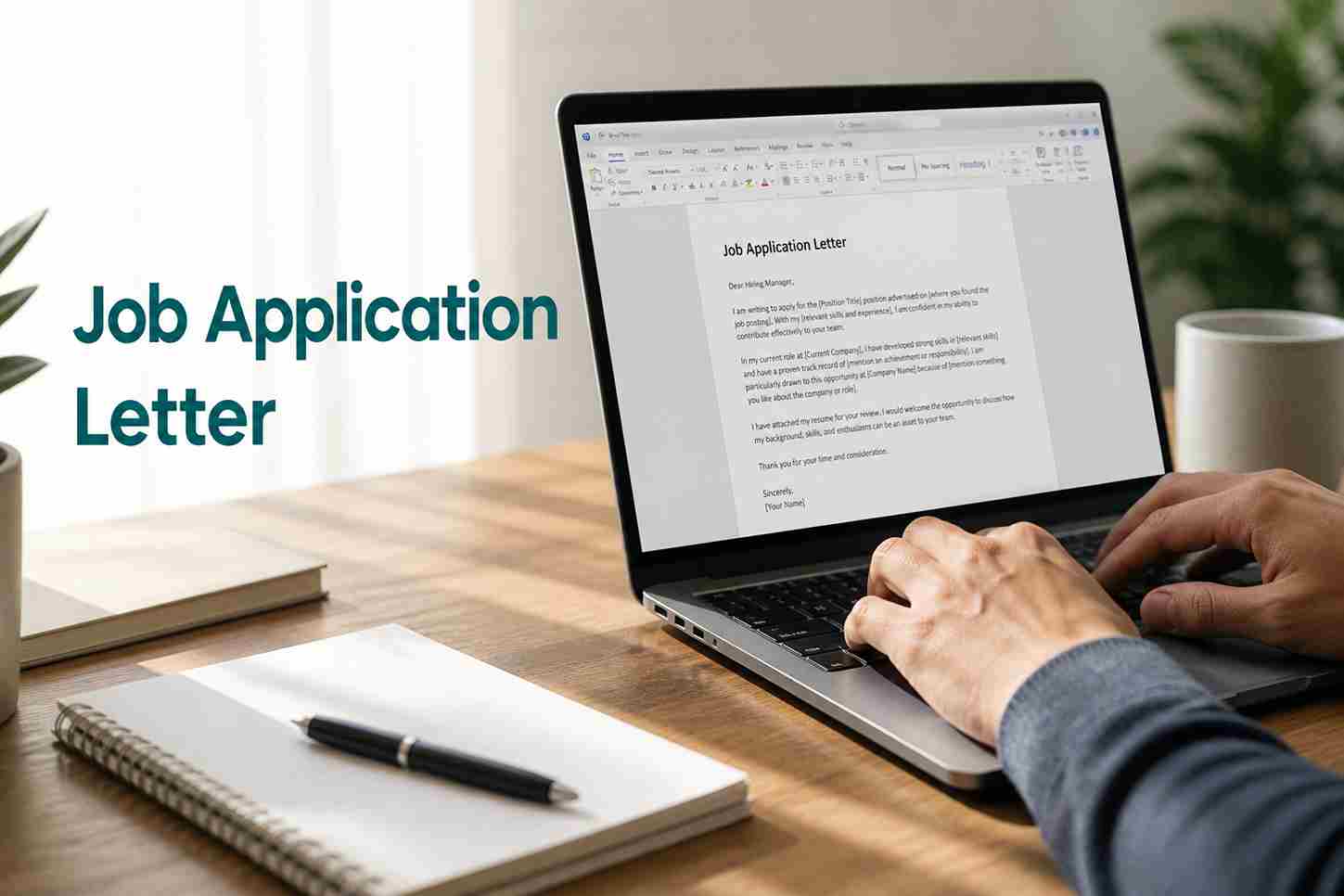
In a competitive hiring landscape, submitting a resume without a compelling job application letter often results in missed opportunities. Recruiters may spend less than a minute scanning an application. In that limited time, clarity, structure and relevance determine whether a candidate moves forward.
A well-written job application letter is not a repetition of the resume. It is a strategic document that explains professional value, aligns experience with job requirements and presents a strong case for shortlisting.
This blog covers everything required to write an effective job application letter, including format, structure, writing strategy, expert tips, common mistakes and detailed samples for both freshers and experienced professionals.
What Is A Job Application Letter?
A job application letter is a formal document submitted along with a resume to apply for a specific position. It introduces the candidate, specifies the role, and explains why the applicant is suitable for the opportunity. Unlike a resume that focuses on structured information such as qualifications, experience and skills, the application letter:
- Explains professional intent
- Connects achievements with employer needs
- Demonstrates written communication skills
- Highlights career direction
- Shows genuine interest in the organization
In many industries, it is also referred to as a cover letter. However, the job application letter is often slightly more detailed and formal in tone.
Standard Job Application Letter Format
Following a structured format improves readability and makes the document professionally aligned with hiring expectations.
1. Candidate Information
- Full Name
- Contact Number
- Professional Email Address
- Date
2. Employer Details
- Hiring Manager’s Name (if available)
- Company Name
3. Subject Line: Application for the Position of Operations Executive
4. Salutation
- Dear Hiring Manager
- Dear Mr./Ms. [Last Name]
5. Opening Paragraph: This section should:
- Clearly mention the job title
- Indicate how the position was discovered
- Briefly introduce professional background
6. Body Paragraph(s): This is the core of the job application letter. It should:
- Highlight relevant experience
- Mention measurable achievements
- Demonstrate understanding of company needs
- Show alignment with the role
7. Closing Paragraph
- Express willingness to discuss further
- Mention attached resume
- Thank the employer for consideration
- Sincerely
- Regards
- Full Name
Maintaining this logical flow ensures clarity and professional presentation.
How To Write A Job Application Letter
Writing a strong job application letter requires strategy. Below is a structured approach.
1. Study The Job Description Carefully: Identify:
- Core responsibilities
- Required technical skills
- Preferred qualifications
- Keywords used in the posting
Integrating relevant keywords naturally improves ATS compatibility.
2. Begin With A Clear And Direct Introduction: Avoid vague openings. The first paragraph should immediately communicate:
- Who the candidate is
- The position applied for
- A brief summary of relevant expertise
Clarity at the beginning encourages further reading.
3. Focus On Achievements, Not Duties: Recruiters value measurable outcomes. Instead of listing responsibilities, highlight impact.
Examples:
- Increased revenue by 22 percent through strategic planning
- Reduced process turnaround time by 30 percent
- Managed a cross-functional team of 12 members
- Improved customer retention rate by 15 percent
Quantified achievements build credibility and authority.
4. Demonstrate Organizational Alignment: A well-written job application letter reflects understanding of:
- Industry trends
- Company objectives
- Market challenges
- Organizational culture
This shows preparation and genuine interest rather than mass application.
5. Maintain Professional Tone And Length: The ideal job application letter:
- Contains 400 to 500 words
- Fits within one page
- Uses concise paragraphs
- Avoids exaggerated claims
Professional tone strengthens impact.
Job Application Letter Sample
Subject: Application for the Position of Senior Business Analyst
| Dear Hiring Manager, With over seven years of experience in data-driven business strategy and performance optimization, this application is submitted for the position of Senior Business Analyst. Professional experience includes requirement analysis, stakeholder coordination, and performance tracking across cross-functional teams. In the current role, responsibility includes leading end-to-end project analysis, identifying operational inefficiencies, and implementing structured reporting frameworks. Recent initiatives resulted in a 28 percent improvement in operational efficiency and enhanced reporting accuracy through automation tools. Experience in collaborating with technology teams and senior leadership aligns closely with the expectations outlined in the job description. Strong analytical capabilities, structured problem-solving, and attention to detail contribute to measurable performance improvements. The resume attached provides further information regarding professional experience and qualifications. An opportunity to discuss how analytical expertise can contribute to strategic objectives would be appreciated. Sincerely, [Full Name] |
Subject: Application for the Position of HR Assistant
| Dear Hiring Manager, This application expresses interest in the HR Assistant role. A recent graduate specializing in Human Resource Management, academic exposure includes recruitment processes, employee engagement frameworks and performance evaluation systems. During an internship with a mid-sized organization, responsibilities included resume screening, interview coordination, on-boarding documentation and maintaining employee records. Participation in campus recruitment drives strengthened communication and organizational skills. Strong interest in talent acquisition and workforce development aligns with the responsibilities outlined in the job description. Commitment to learning and adaptability can contribute positively to the HR team. The attached resume provides additional details. Consideration for an interview would be highly valued. Regards, [Full Name] |
Why Does A Job Application Letter Matters?
With job portals offering quick-apply options, many candidates overlook the importance of a customized letter. However, recruiters continue to value this document for several practical reasons. A strong job application letter:
- Differentiates one candidate from hundreds of similar resumes
- Demonstrates preparation and research
- Provides context to career transitions
- Highlights role-specific achievements
- Reflects professionalism and clarity
For positions in management, marketing, HR, finance, consulting and communication-oriented roles, the application letter becomes a significant evaluation factor.
Mistakes In A Job Application Letter
Avoiding these errors significantly improves quality:
- Using a generic template for multiple roles
- Copying resume content directly
- Writing lengthy, unstructured paragraphs
- Including unrelated personal information
- Using informal language
- Mentioning incorrect company name
- Failing to proofread
Attention to detail reflects seriousness and professionalism.
Tips To Improve Shortlisting Chances
To strengthen a job application letter further:
- Match tone with industry (formal for finance, slightly creative for marketing)
- Keep formatting simple and ATS-friendly
- Use consistent font style and size
- Save the file as PDF unless instructed otherwise
- Name the file professionally (e.g., Full Name_Application Letter.pdf)
- Avoid unnecessary graphics or design elements
Strategic formatting enhances readability and system compatibility.
Conclusion
A thoughtfully drafted job application letter remains one of the most powerful tools in a professional job search. It communicates intent, highlights measurable achievements and shows alignment with organizational goals.
While resumes present structured qualifications, the job application letter tells the professional story behind those qualifications. Clear structure, relevant keywords, measurable results and a concise format together enhance shortlisting probability.
In a competitive employment environment, investing time and effort into crafting a customized job application letter can significantly influence hiring outcomes.
Read: What Is a Resume Headline?
FAQs
1. What is the ideal length of a job application letter?
The ideal length is 400 to 500 words, within one page.
2. Should every job application include a letter?
Including a customized job application letter increases credibility and professionalism.
3. Can the same letter be used for different companies?
Customization is essential, generic letters reduce impact.
4. Should achievements be quantified?
Yes,measurable results strengthen credibility.
5. Is it necessary to address the hiring manager by name?
If available, personalization improves professionalism.
6. Can freshers write effective job application letters?
Yes. Academic projects, internships, certifications and relevant skills can be highlighted.
7. Should salary expectations be mentioned?
Only if specifically requested.
8. Is the email body considered a job application letter?
Yes, in many digital applications, the email body functions as the letter.
9. What font style is recommended?
Professional fonts such as Arial, Calibri or Times New Roman are preferred.
10. How important is proofreading?
Extremely important, even minor grammatical errors can reduce credibility.





 Facebook
 Instagram
 Twitter




