


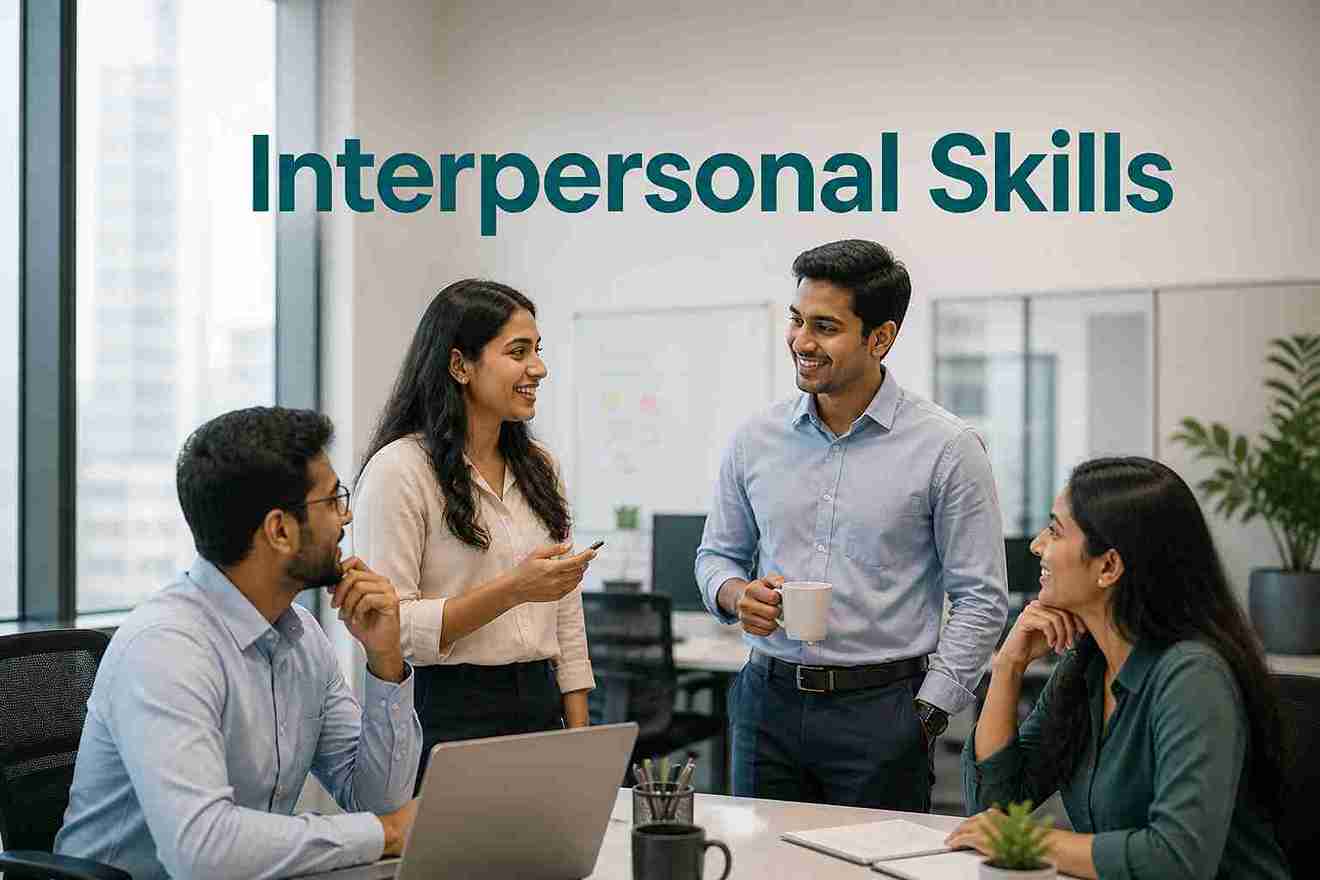
In today’s professional landscape, technical expertise alone no longer guarantees career success. Employers increasingly value interpersonal skills, the human-centered abilities that enable effective communication, collaboration and relationship building. Whether in job interviews, performance reviews, teamwork or leadership scenarios, strong interpersonal skills empower individuals to thrive in diverse workplace environments.
This comprehensive blog explores what interpersonal skills are, why they matter, real-world examples, ways to improve them and how they impact in professional growth.
What Are Interpersonal Skills?
Interpersonal skills are the abilities that facilitate effective interaction and communication with others. These skills influence how people connect, convey ideas, resolve conflicts, and build professional relationships. They are sometimes called people skills or social skills, reflecting strengths in empathy, listening, collaboration and emotional intelligence.
In essence, interpersonal skills help individuals engage respectfully and productively with colleagues, clients, supervisors and teams.
Why Interpersonal Skills Matter In The Workplace
Today’s work environments are collaborative, interconnected, and culturally diverse. Even if a role is highly technical, the ability to work well with others remains a differentiator. Here’s why interpersonal skills are essential:
- Enhances Teamwork: Trust and cooperation grow when team members communicate clearly and respectfully.
- Improves Conflict Resolution: Strong interpersonal skills reduce misunderstandings and help manage disagreements constructively.
- Boosts Leadership: Leaders depend on rapport, persuasion and empathy to motivate others.
- Improve Customer Relations: Customer-facing roles require approachable communication and positive engagement.
- Promotes A healthy Work Culture: Respectful interactions strengthen organizational morale and engagement.
In summary, professionals who master interpersonal skills are more adaptable, influential and marketable.
Interpersonal Skills Employers Look For
Here are key interpersonal skills that consistently appear in job descriptions and employee evaluations:
1. Communication: Expressing ideas effectively, both verbally and in writing.
2. Active Listening: Fully concentrating and responding thoughtfully to others.
3. Empathy: Understanding and valuing other people’s perspectives.
4. Collaboration: Working cooperatively in teams toward shared goals.
5. Conflict Resolution: Finding solutions that satisfy multiple parties.
6. Emotional Intelligence (EQ): Managing emotions and recognizing the feelings of others.
7. Adaptability: Adjusting behavior to suit different situations and people.
8. Positive Attitude: Showing optimism and encouraging others.
9. Problem-Solving: Using logic and creativity in interpersonal scenarios.
10. Patience: Remaining calm during complex or stressful exchanges.
11. Respectfulness: Valuing diversity and treating others with dignity.
12. Feedback Receptivity: Accepting constructive feedback gracefully.
13. Persuasion: Influencing others with integrity and clarity.
14. Networking: Building mutually beneficial professional relationships.
15. Cultural Awareness: Interacting respectfully across different backgrounds.
Understanding these skills helps job seekers tailor resumes, prepare for interviews and succeed in the workplace.
Examples Of Interpersonal Skills In Action
To show how these skills appear in real settings, consider these scenarios:
Scenario 1: Team Project Collaboration: During a cross-department project, a team member clearly communicates expectations, listens to feedback from IT and marketing, and negotiates timelines that account for both perspectives. This reflects communication, active listening, and collaboration.
Scenario 2: Conflict Between Colleagues: Two employees disagree on prioritizing tasks. A manager uses empathy and conflict resolution to explore each viewpoint, re-framing the discussion around shared goals and defining next steps peacefully.
Scenario 3: Client Presentation: A customer success specialist delivers a presentation using confident speech, addresses concerns without becoming defensive, and follows up with personalized support. This example highlights positive attitude, persuasion and problem-solving.
These real-life illustrations clarify how interpersonal skills influence outcomes at every level.
How To Add Interpersonal Skills On A Resume
Interpersonal skills cannot just be claimed, they must be demonstrated. Here’s how:
On a Resume:
Use specific achievements and measurable outcomes to show interpersonal strengths:
- “Led cross-functional team of 10 to achieve a 20% increase in quarterly sales by improving interdepartmental communication.”
- “Resolved client complaints with a 95% satisfaction rate through empathetic listening and timely follow-ups.”
These examples show how skills were applied with results.
In Job Interviews:
- Storytelling: Use STAR (Situation, Task, Action, Result) framework to describe interpersonal challenges and outcomes.
- Active listening during questions: Wait for the full question, respond thoughtfully and clarify if needed.
- Positive body language: Maintain eye contact, nod in engagement and avoid closed postures.
Interviewers often assess interpersonal skills from the first greeting to closing remarks, so every interaction matters.
Techniques To Improve Interpersonal Skills
Enhancing interpersonal skills is a proactive process. Consider these practical techniques:
Practice Active Listening
- Avoid interrupting.
- Summarize what you hear before responding.
- Acknowledge emotions as well as facts.
Observe And Adapt
- Pay attention to cultural norms and individual preferences.
- Adjust your communication style accordingly.
Seek Feedback
- Ask trusted peers or mentors how you come across in interactions.
- Use feedback constructively.
Engage in Group Activities
- Collaborate outside of work through volunteer teams, clubs, or study groups.
- These provide low-pressure environments to refine people skills.
Learn Emotional Intelligence
- Identify your own emotional triggers and learn calming techniques.
- Practice empathy by putting yourself in other’s shoes.
Difference Between Interpersonal Skills & Soft Skills
While the terms interpersonal skills and soft skills are often used interchangeably, they are not identical:
Soft Skills: These are all the personal qualities that affect how a person works.
Example: time management, discipline, adaptability.
Interpersonal Skills: These are the skills used when dealing with other people.
Example: communication, teamwork, listening.
Understanding this distinction helps professionals craft targeted development plans and optimized resume language.
Benefits Of Interpersonal Skills In Career Growth
Employees strong in interpersonal skills often experience:
- Higher performance evaluations
- Greater leadership opportunities
- Stronger professional networks
- Increased job satisfaction
- Enhanced team cohesion
These benefits translate into long-term career advantages, from promotions to future job mobility.
Common Mistakes In Interpersonal Communication
Even skilled communicators can stumble. Here are frequent pitfalls:
- Assuming Understanding: Never assume others interpret messages the same way you do
- Failing To listen: Thinking about your answer instead of listening
- Overreacting Emotionally: Letting emotions override clarity and respect
- Interrupting Others: Cutting off speakers reduces trust and respect
- Avoiding Feedback: Ignoring constructive criticism stalls growth
Recognizing these mistakes is the first step toward correcting them.
Conclusion
Interpersonal skills are critical human competencies that fuel effective communication, teamwork, leadership and positive work environments. Defined by empathy, active listening, collaboration and adaptability, these skills benefit individuals across industries and career stages.
Professionals can showcase interpersonal skills through measurable achievements, interview storytelling and daily workplace behavior. Most importantly, these skills are learnable and increasingly valued in the modern workplace. Developing strong interpersonal skills not only enhances personal relationships but also catalyzes career success.
FAQs
Q: Are interpersonal skills important for remote work?
Yes, remote work requires clear communication, active listening and empathy to bridge physical distance and maintain collaboration.
Q: Can interpersonal skills be learned?
Absolutely, with practice, feedback, and self-awareness, interpersonal skills improve over time.
Q: How do employers assess interpersonal skills?
Employers use interviews, group activities, behavioral questions and reference checks to evaluate interpersonal strengths.
Q: What is the most valued interpersonal skill?
Communication often tops the list, but empathy and active listening are equally crucial in building trust.
Q: Which jobs require strong interpersonal skills?
All jobs benefit from interpersonal skills, especially leadership roles, customer service, project management and team-based positions.
Q: What is the main difference between soft skills and interpersonal skills?
Soft skills include all personal qualities that affect how a person works, while interpersonal skills focus specifically on how a person communicates and interacts with others.
Q: Are interpersonal skills part of soft skills?
Yes, interpersonal skills are a subset of soft skills. All interpersonal skills are soft skills, but soft skills also include individual traits like time management and self-discipline.
Q: Why are interpersonal skills important in the workplace?
Interpersonal skills help in teamwork, communication, conflict resolution and building strong professional relationships, which are essential for career growth.
Q: Can someone have soft skills but weak interpersonal skills?
Yes, a person may be good at managing time and staying disciplined (soft skills) but still struggle with communication or teamwork (interpersonal skills).
Q: How can interpersonal skills be improved easily?
Interpersonal skills can be improved by practicing active listening, improving communication, being empathetic and engaging in team activities regularly.



 Facebook
 Instagram
 Twitter




