


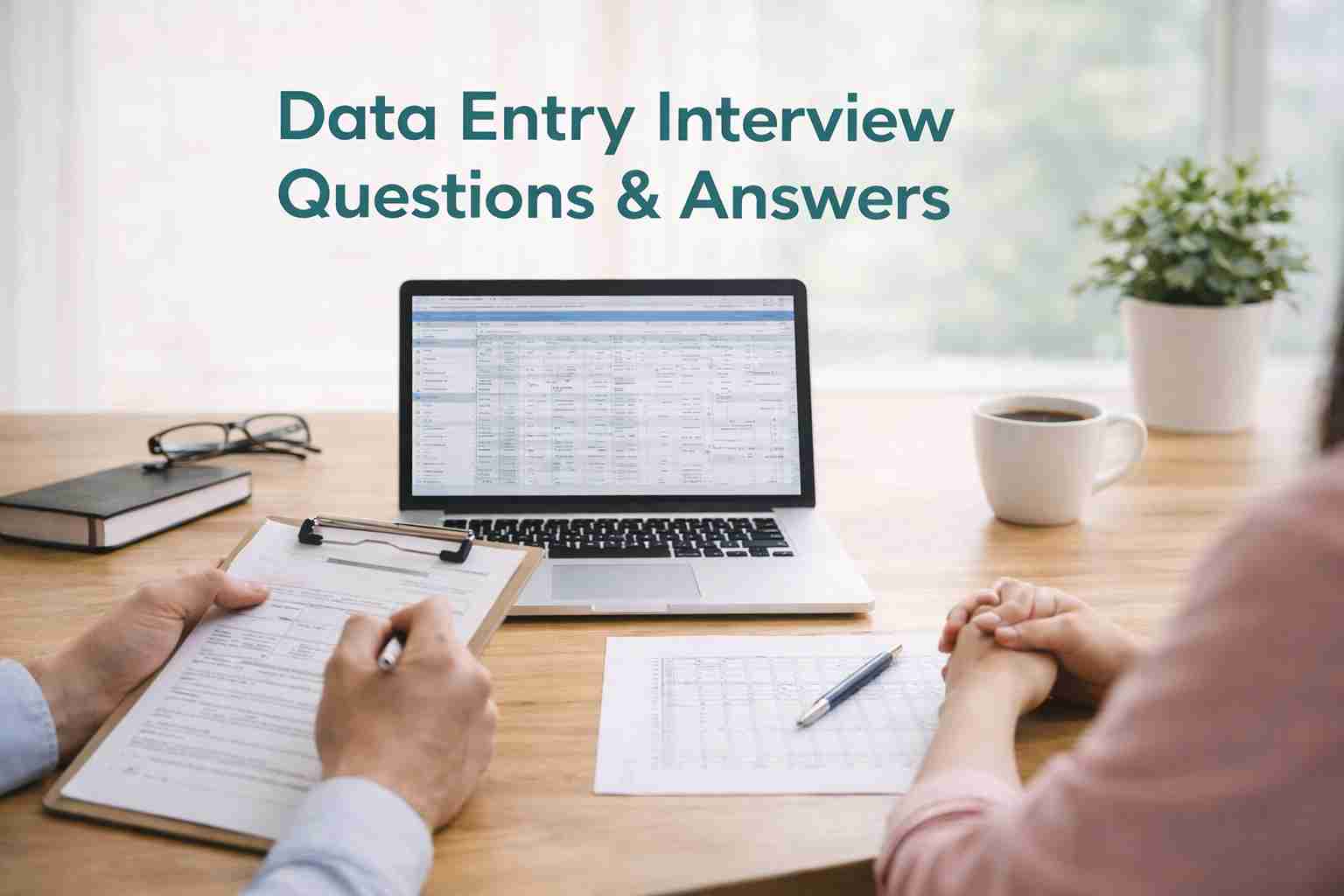
Data entry is one of the most accessible career options for freshers and job seekers looking to start quickly. It does not always require a technical degree, yet it demands accuracy, focus and consistency. Because of this, interviews for data entry roles are often practical and skill-based rather than theoretical.
Understanding what employers expect in a data entry interview can make a big difference. A well-prepared candidate not only answers correctly but also shows attention to detail, clarity in communication and confidence.
This blog covers everything in one place, top data entry interview questions, sample answers, required skills, eligibility, salary, career scope and FAQs.
What Is A Data Entry Job
Data entry is the process of entering, updating, and managing information in a computer system or database. A data entry job involves doing this work to keep information accurate and well organized. It is an important role in day to day business operations, where both speed and accuracy matter.
In simple terms, a data entry job means taking information from different sources such as documents, forms or digital files and entering it into software like spreadsheets or company systems. The work also includes checking and updating data to make sure it is correct.
Skills Required For Data Entry Jobs


To succeed in a data entry role, certain practical skills are expected. These are often tested directly or indirectly during interviews. Core skills employers look for:
- Fast and accurate typing speed
- Basic knowledge of MS Excel and MS Word
- Attention to detail
- Time management
- Ability to handle repetitive tasks
- Basic computer knowledge
- Data confidentiality awareness
Additional skills that give an advantage:
- Familiarity with Google Sheets
- Basic understanding of databases
- Communication skills
- Ability to meet deadlines consistently
Educational Qualification And Course Duration
One of the biggest advantages of data entry jobs is that the entry barrier is low.
Basic eligibility:
- Minimum qualification: 10th or 12th pass
- Many companies prefer graduates, but it is not mandatory
Courses that help:
- Basic computer course (3 to 6 months)
- Typing course (1 to 3 months)
- Excel certification (optional but useful)
A candidate can become job-ready within 3 to 6 months with consistent practice.
Must Read: What To Do After Graduation: Career Paths & Salary
Salary And Career Growth In Data Entry
Salary in data entry depends on experience, typing speed and company type.
Average salary In India:
Fresher: ₹10,000 to ₹18,000 per month
1 to 3 years experience: ₹18,000 to ₹30,000 per month
Experienced roles: ₹30,000+ per month
Career Growth Opportunities:
Data Entry Operator → Senior Data Entry Operator
Office Executive
MIS Executive
Back Office Executive
Data Analyst (with upskilling)
With time and skill improvement, this role can lead to better-paying administrative or analytical positions.
Data Entry Interview Sample Answers
1. What is data entry?
Sample Answer: Data entry is mainly about entering and managing information in a computer system or database. From what I understand, it includes tasks like typing data from documents, updating records in Excel, and keeping everything organised. Even though it looks simple, it actually requires a lot of focus because even small mistakes can create bigger problems later.
2. What is your typing speed?
Sample Answer: My typing speed is around 40 to 50 words per minute with good accuracy. I usually focus more on entering the data correctly rather than just typing fast. With regular practice, my speed and consistency have both improved over time.
3. How do you ensure accuracy in your work?
Sample Answer: To maintain accuracy, I try to stay focused on one task at a time and avoid distractions. Once the work is done, I make it a habit to cross-check everything to catch any errors. Breaking the work into smaller parts also helps me stay consistent and reduces mistakes.
4. What software are you familiar with?
Sample Answer: I am comfortable using MS Excel and MS Word for daily data entry tasks like formatting and managing records. I have also worked with Google Sheets for online data handling. Basic functions like sorting, filtering, and simple formulas are easy for me to manage.
5. How do you handle repetitive tasks?
Sample Answer: I try to maintain a steady pace while working on repetitive tasks so that accuracy is not affected. Taking short breaks in between helps me stay fresh and focused. Over time, I have also developed a routine that makes such tasks easier to handle.
6. What would you do if you found an error in data?
Sample Answer: If I find an error, I first go back to the original source to check the correct information. Once confirmed, I correct it immediately. If the mistake affects other data or reports, I make sure to inform the concerned person so that it does not create further issues.
7. Why do you want this job?
Sample Answer: This role matches my current skills like typing, basic computer knowledge, and attention to detail. I also see it as a good opportunity to start working in a professional environment and learn how things operate in an office. Over time, I would like to improve my skills and grow into better roles.
8. How do you manage deadlines?
Sample Answer: To manage deadlines, I usually plan my work in advance and prioritize tasks based on urgency. I break the work into smaller parts so that it feels more manageable. This helps me complete tasks on time without affecting accuracy.
9. Are you comfortable working long hours on a computer?
Sample Answer: Yes, I am comfortable working on a computer for long hours. I make sure to take short breaks and maintain proper posture so that I do not feel tired. With time, I have become used to working for extended hours.
10. What are your strengths?
Sample Answer: One of my biggest strengths is attention to detail. I can stay focused on tasks for a long time without getting distracted. I also have a habit of checking my work before submitting it, which helps maintain accuracy.
11. What are your weaknesses?
Sample Answer: Sometimes I spend extra time checking my work because I want to avoid mistakes. This can slow me down a bit. However, I am working on balancing speed and accuracy so that I can complete tasks more efficiently.
12. How do you handle confidential data?
I understand that confidential data needs to be handled very carefully. I make sure not to share any information unnecessarily and follow all company rules related to data privacy. Maintaining trust and security is very important in this role.
13. What motivates you in this role?
Completing work accurately and on time gives me a sense of satisfaction. I feel motivated when the data is well organised and error free. I also like learning new tools, especially in Excel, which keeps the work interesting.
Tips To Crack Data Entry Interviews
A data entry interview may look easy, but recruiters pay close attention to small details like accuracy, clarity and consistency. A little preparation can make a strong difference in performance and confidence.
Before The Interview
- Practice Typing Daily: Typing is one of the most important skills for this role. Regular practice helps improve both speed and accuracy. Even 20 to 30 minutes of daily typing practice can make a noticeable difference. Focus not only on speed but also on reducing errors.
- Learn Basic Excel Functions: Most data entry jobs require working on Excel or similar tools. Basic knowledge like sorting data, filtering and simple formulas (such as sum and average) is often expected. Being comfortable with Excel makes work faster and shows job readiness.
- Prepare Common Answers: Questions like typing speed, accuracy, strengths and handling errors are commonly asked. Preparing answers in advance helps avoid confusion during the interview and allows more confident responses.
- Keep Resume Simple And Clear: A data entry resume should be clean and easy to read. Highlight typing speed, computer skills and any relevant experience. Avoid adding unnecessary details and keep the format organized.
During The Interview
- Speak Clearly And Confidently: Clear communication creates a strong first impression. Answers do not need to be complex, but they should be explained in a simple and structured way. Confidence matters more than perfect wording.
- Be Honest About Skills: It is better to share real typing speed and actual knowledge rather than exaggerating. Employers often test skills practically, so honesty helps avoid problems later.
- Focus On Accuracy And Discipline: Recruiters look for candidates who value accuracy over speed. Showing a careful and disciplined approach to work reflects reliability and professionalism.
- Avoid Guessing Answers: If unsure about a question, it is better to admit it politely rather than giving a wrong answer. A willingness to learn is always seen as a positive attitude.
Conclusion
Data entry is one of the smartest doors a fresher can walk through. It quietly builds the habits every employer values like precision, discipline, and consistency. The barrier to entry is low, but the ceiling is not. As your speed improves and confidence grows, better opportunities naturally start to open up.
So if you are standing at the start of your professional journey, unsure of where to begin, data entry gives you something rare: a real job, real experience and a real foundation to build on.
FAQs
1. Is data entry a good job for freshers?
Yes, data entry is a good starting point for freshers. It does not require advanced qualifications and helps build basic office skills like typing, accuracy and time management. It also gives exposure to real work environments early in a career.
2. Can data entry jobs be done from home?
Many companies offer work from home data entry jobs. However, it is important to apply through trusted platforms and avoid jobs that ask for registration fees. Checking company reviews before applying can help avoid scams.
3. What typing speed is required for data entry jobs?
Most companies expect a typing speed of at least 30 to 40 words per minute with good accuracy. Higher speed can increase chances of selection. Regular practice can gradually improve both speed and confidence.
4. Do I need a degree for a data entry job?
A degree is not always required. Many employers accept candidates who have completed 10th or 12th, as long as they have basic computer knowledge. Short-term computer courses can further improve job chances.
5. Is data entry a stressful job?
Data entry is not very stressful, but it does require focus and patience. Work can feel repetitive at times, so staying consistent is important. Taking short breaks can help maintain productivity.
6. How much can a beginner earn in data entry?
A beginner can earn around ₹10,000 to ₹18,000 per month. Salary increases with experience, typing speed and skill level. Better-paying roles are possible with additional skills like Excel.
7. What skills are most important for data entry?
Typing speed, accuracy, basic Excel knowledge and attention to detail are the most important skills for this role. Time management also plays a key role in meeting deadlines.
8. Are data entry jobs safe or are there scams?
Genuine data entry jobs are safe, but there are many scams in the market. It is best to avoid offers that promise very high income or ask for money upfront. Always apply through trusted job platforms.
9. How can I improve my typing speed at home?
Typing speed can be improved by practicing daily using free typing tools. Maintaining proper finger placement and focusing on accuracy helps in long term improvement. Consistency is more important than speed in the beginning.
10. What is the career growth after data entry jobs?
With experience, candidates can move to roles like MIS Executive, Back Office Executive or administrative positions. Learning advanced Excel can open better opportunities. Over time, this can lead to higher-paying office roles.

 Facebook
 Instagram
 Twitter




