


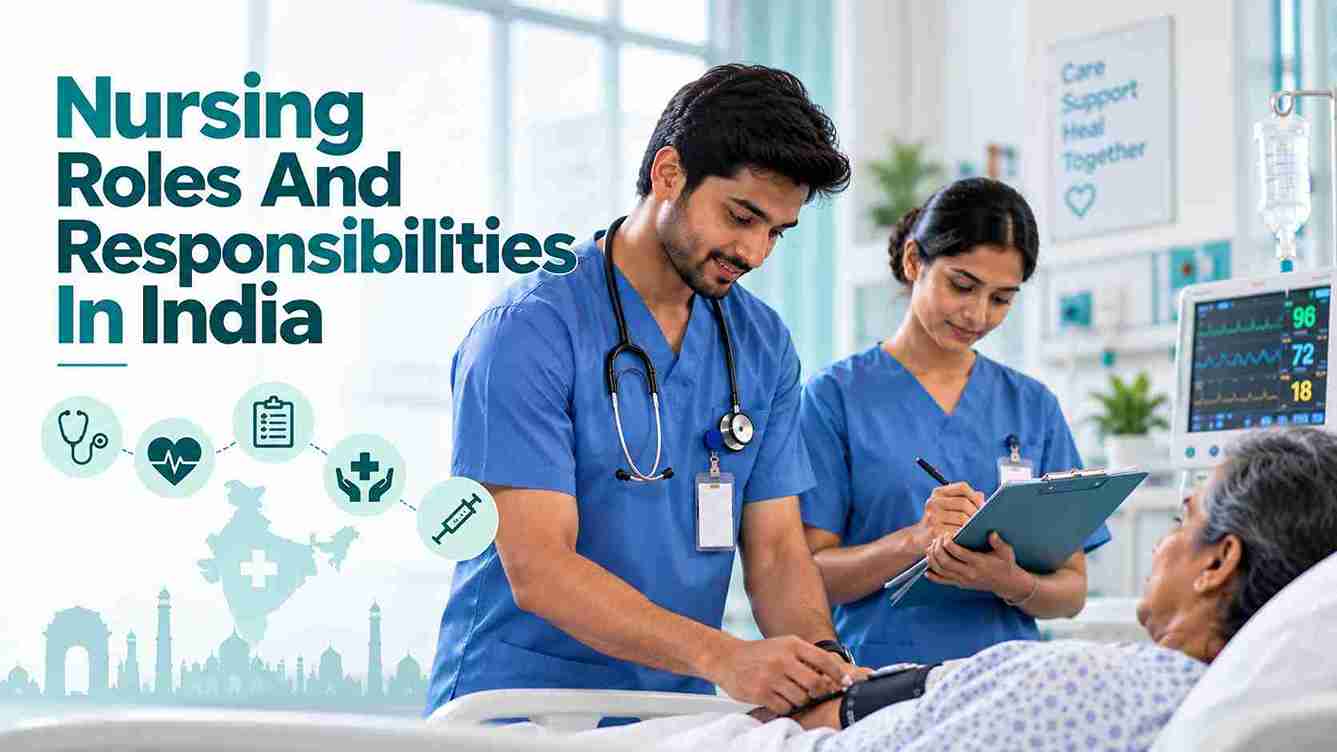
Ever been in a hospital and wondered who is really keeping everything running? It is not just the doctor. It is the nurse standing right beside you, checking your vitals, managing your care, noticing small changes and making sure you feel safe.
Nursing is one of the most important and in-demand careers in India, yet it is often underrated. For anyone considering a career in healthcare, or already studying nursing, understanding the full picture matters. This blog covers everything, including daily responsibilities, education, salary and long term career growth.
Let us get started.
What Does A Nurse Actually Do?
1. Patient Care And Monitoring
This is the heart of the job. Nurses are responsible for monitoring patients around the clock. They check vital signs like blood pressure, pulse, temperature, and oxygen levels at regular intervals. They observe changes in a patient’s condition and report anything unusual to the doctor immediately. Every shift, a nurse is the first person a patient calls when something feels wrong.
2. Administering Medication
Nurses are trained and authorized to administer medicines, injections, and IV fluids as prescribed by doctors. They check dosages carefully, confirm the right patient is receiving the right medication, and watch for any reactions after administration. This is a critical responsibility because even a small error can have serious consequences.
3. Assisting In Procedures and Surgeries
In operation theaters, ICUs, and emergency rooms, nurses assist doctors during medical procedures. They prepare the equipment, hand over surgical instruments, monitor the patient during the procedure, and ensure the environment stays sterile.
4. Wound Care And Dressing
Nurses handle dressings for post surgery wounds, burns, pressure sores, and injuries. They clean wounds, apply the right dressings, and track the healing process.
5. Maintaining Medical Records
A huge part of a nurse’s job is documentation. Every observation, every medication given, every procedure performed, and every change in the patient’s condition must be accurately recorded. These records help doctors make better decisions and are also legally important.
6. Patient And Family Education
Nurses do not just care for patients physically. They also explain to patients and their families what the treatment involves, how to take medicines at home, what signs to watch out for, and how to manage recovery. Clear communication at this stage can literally prevent readmission to the hospital.
7. Emergency Response
In any emergency, nurses are often the first trained healthcare professionals on the scene. Whether it is a sudden drop in blood pressure, a patient going into shock, or a cardiac event, nurses initiate the first response until a doctor arrives.
8. Infection Control
Nurses follow and enforce hygiene protocols to prevent hospital acquired infections. They make sure wards are sanitized, equipment is sterilized and isolation protocols are followed when needed.
9. Mental And Emotional Support
This one does not get talked about enough. Being in a hospital is a stressful experience for patients and their families. Nurses provide emotional comfort, reassurance, and a calm presence. This kind of care is just as important as any medication.
Types Of Nurses And Their Specific Roles


Nursing is not a single job. It branches into many specializations depending on the healthcare setting.
- Staff Nurse: Works in general wards, handling day to day patient care across a hospital department
- ICU Nurse: Works in the Intensive Care Unit with critically ill patients. Requires advanced training and the ability to handle complex equipment
- OT Nurse / Scrub Nurse: Assists surgeons in the operation theater
- Emergency Room (ER) Nurse: Works in emergency settings and must make fast, accurate decisions under pressure
- Maternity and Labor Nurse: Assists with childbirth, postnatal care, and newborn care
- Pediatric Nurse: Specializes in the care of children from infants to teenagers
- Psychiatric Nurse: Works with patients facing mental health conditions
- Community Health Nurse: Works outside hospitals in clinics, schools and community health programs, often in rural areas
- Home Care Nurse: Provides nursing care to patients in their homes, especially elderly patients or those recovering from illness
- Oncology Nurse: Specializes in the care of cancer patients
Skills Every Nurse Needs
Nursing requires a strong combination of technical knowledge and human qualities. Here is what employers look for.
- Clinical Skills: These are the hard skills that are non-negotiable. Vital sign monitoring, IV insertion, catheterization, wound dressing, medication administration, use of medical devices and basic life support (BLS) are all things every nurse must know and practice confidently.
- Attention to Detail: A small error in a patient’s dosage or a missed change in vital signs can be life threatening. Nurses must be meticulous in everything they do.
- Communication Skills: A nurse communicates with doctors, patients, families, and other nurses every single hour. Being clear, empathetic, and professional in all these interactions is essential. If you want to work on your communication skills, check out this helpful read on non verbal communication which matters just as much in a hospital setting.
- Time Management: In a busy ward, a nurse can be responsible for five to ten patients at the same time. Prioritizing who needs attention first, managing medication schedules, and completing documentation all within a shift is a skill in itself.
- Critical Thinking: Nurses need to assess a situation quickly and make smart decisions. When a patient’s condition changes suddenly, there is no time to wait. Nurses analyze symptoms, take immediate action, and communicate findings clearly to the doctor.
- Emotional Resilience: Working in healthcare means dealing with illness, pain, grief, and sometimes loss on a daily basis. Nurses need emotional strength and a way to cope with this without burning out.
- Teamwork: A hospital runs as a team. Nurses work closely with doctors, lab technicians, physiotherapists, housekeeping staff, and other nurses. Being a reliable, cooperative team member is not optional.
- Technology Literacy: Modern hospitals use electronic health records, monitoring software, infusion pumps, ventilators, and various digital tools. Nurses need to be comfortable operating and troubleshooting these systems.
Education Required To Become A Nurse
There is more than one path into nursing, and the right one depends on how much time you have and how far you want to go in the field. Given below are education mentioned to become a nurse:
1. ANM (Auxiliary Nurse Midwife) – 2 years
This is the entry level nursing course. It prepares students for basic healthcare roles, mainly in rural and community settings.
Eligibility: Class 12th pass from a recognized board, in any stream. The minimum age for admission is 17 years.
Career scope: Primary health centers, government hospitals and community health programs.
2. GNM (General Nursing and Midwifery) – 3 years
This is a diploma course that focuses on practical hospital training. It is more detailed than ANM and allows nurses to work in most hospital settings.
Eligibility: 10+2 with English and at least 40% marks. Science is preferable. Other recognised streams may also be eligible as per INC criteria
After completion, registration with the Indian Nursing Council or state nursing council is required.
3. B.Sc Nursing – 4 years
This is a widely recognised undergraduate nursing degree in India. It combines classroom learning with strong clinical exposure. It offers better job roles, faster growth, and higher salary potential.
Eligibility: 10+2 with Science (Physics, Chemistry and Biology) and English, with at least 45% aggregate marks. Admission requirements may vary by institution and applicable admission rules.
After completing the course, candidates must register with the relevant State Nursing Registration Council.
4. Post Basic B.Sc Nursing – 2 years
This course is designed for GNM graduates who want to upgrade their qualification to a degree level. It helps in career growth, better job roles, and eligibility for higher studies.
Eligibility: Candidates must have completed GNM and be registered as R.N. & R.M. with a State Nursing Registration Council.
Career scope: Staff nurse roles in top hospitals, opportunities for promotions, and eligibility for M.Sc Nursing.
5. M.Sc Nursing – 2 years
This course focuses on specialization in areas like pediatrics, psychiatric nursing, oncology, and community health. It is ideal for those who want to move into advanced clinical roles or teaching.
Eligibility: B.Sc Nursing, B.Sc. (Hons.) Nursing or Post Basic B.Sc Nursing with the required minimum marks and other applicable eligibility requirements.
Career scope: Nurse educator, specialist nurse, hospital administrator, and research roles.
6. Specialty Certifications
These are short term courses that help nurses build expertise in specific areas like critical care, operation theater, dialysis, and emergency care. They add strong value to a profile and improve job prospects.
Eligibility: Requirements vary depending on the specific programme and institution. Many specialty courses require a prior nursing qualification.
Career scope: Higher paying roles in specialized departments and faster career growth.
Nursing Salary In India
1. Freshers (0 to 1 year experience)
A fresh nursing graduate can expect to earn between ₹15,000 to ₹30,000 per month in most private hospitals. In metro cities like Delhi, Mumbai, and Bengaluru, starting salaries are on the higher side. Government hospitals offer structured pay scales with better job security, typically starting around ₹25,000 to ₹35,000 per month for staff nurses. However, Government nursing salaries vary by state, post and pay level and may include applicable allowances
2. Mid Level (3 to 5 years experience)
As you gain experience and take on more responsibilities, monthly earnings can rise to ₹35,000 to ₹60,000 depending on the hospital, specialization, and location.
3. Senior Level (10 plus years)
Experienced nurses in leadership or specialized roles like ICU Nurse Manager, Nursing Superintendent, or Nurse Educator can earn anywhere from ₹60,000 to ₹1,00,000 per month or more.
4. Government Nursing Jobs
Government hospitals under schemes like AIIMS, NHM, PGIMER, and ECHS offer structured salary bands. An AIIMS Nursing Officer, for instance, starts at approximately ₹44,900 per month under the 7th Pay Commission, with Grade Pay and additional allowances like HRA, DA, and medical benefits.
5. Private Multi-specialty Hospitals
Top tier private hospitals often offer higher base salaries but may vary in allowances and job security compared to government roles.
Career Scope And Growth In Nursing
Nursing is not a dead end job. There is a clear and structured path forward for those who are willing to grow.
- Clinical Ladder: Staff Nurse → Senior Nurse → Charge Nurse → Head Nurse → Nursing Supervisor → Nursing Superintendent → Director of Nursing Services.
- Specialization Roles: ICU Nurse, OT Nurse, Oncology Nurse, Psychiatric Nurse, NICU Nurse, Dialysis Nurse.
- Education and Research: With an M.Sc in Nursing, you can move into nursing faculty positions at colleges, pursue a Ph.D., or work in research settings.
- Public Health: Community Health Officer (CHO) roles, National Health Mission (NHM) positions, and rural health programs.
- International Opportunities: With IELTS and the right certifications, Indian nurses can work in GCC countries, UK, Australia, Canada, New Zealand, and more.
- Healthcare Administration: Experienced nurses often move into hospital administration, quality management, and healthcare operations roles.
India’s healthcare sector is growing quickly, more hospitals are being built, and private healthcare services are also expanding. This has increased the demand for trained nurses across the country.
At the same time, there is still a shortage of qualified nurses in India. Because of this, nursing offers strong job security and steady career opportunities.
How To Write A Strong Nursing Resume
If you are applying for a nursing job, your resume is your first impression. Make it count. Highlight your clinical skills, certifications, registration number and any specialized training. Use clear headings and keep it professional.
If you are not sure how to frame your goals? Check out this guide on career objectives for your resume which walks you through how to write a strong objective that gets you shortlisted.
Also, many hospitals use applicant tracking systems to filter resumes before a human even sees them. Using the right keywords from the job description increases your chances. And once you clear that round, you will want to know the right questions to ask in an interview to leave a strong impression.
When you are ready to apply, pairing your resume with a thoughtful cover letter can also make a real difference, especially when you are applying to competitive roles.
Conclusion
Nursing is not just a job. It is one of those careers where you go home every day knowing you made a difference in someone’s life. The responsibilities are wide, the learning never stops, and the opportunities both in India and abroad are only growing.
Whether you are just starting to explore this field, preparing to apply for your first nursing job, or looking to upskill and move into a specialization, the path forward is clear if you know where to start.
FAQs
1. Is nursing a good career option in India?
Yes, nursing is an excellent career choice in India right now. The demand for trained nurses is growing faster than the supply. Government initiatives, private hospital expansion and medical tourism are all fueling this demand. It offers stable employment, structured career growth and increasing salaries.
2. What is the minimum qualification to become a nurse in India?
You can start with an ANM course after Class 12 or a GNM diploma after Class 12 with science. For better opportunities, a B.Sc in Nursing after completing 10+2 with PCB is the most recommended path.
3. Do I need NEET to get into a B.Sc Nursing program?
NEET is not mandatory for all nursing colleges. Some states and private colleges have their own entrance tests, while others admit on merit. Always check the specific requirements of the institution you are applying to.
4. What is the difference between ANM, GNM, and B.Sc Nursing?
ANM is a basic diploma focused on community and primary health care. GNM is a more comprehensive diploma that prepares nurses for hospital settings. B.Sc Nursing is a full four year degree that offers the most career opportunities and is preferred for senior roles.
5. What is the starting salary for a nurse in India?
Freshers in private hospitals typically start at ₹15,000 to ₹30,000 per month. Government hospital roles start higher, often at ₹25,000 to ₹35,000 per month, plus allowances.
6. Can nurses work abroad after completing their degree in India?
Yes, Indian nursing graduates are highly valued internationally. With the right certifications and language proficiency tests like IELTS, you can work in UAE, Canada, UK, Australia and more.
7. What are the highest paying specializations in nursing?
ICU nursing, operation theater nursing, oncology nursing, neonatal intensive care (NICU) and cardiac care nursing tend to offer the highest pay. Nurse Practitioners and Clinical Nurse Specialists also command premium salaries.
8. Is nursing stressful? How do nurses manage it?
Nursing can be demanding, both physically and emotionally. Long shifts, night duties and exposure to illness and grief are real challenges. Most nurses build coping strategies over time through strong support networks, physical activity and mental health awareness.
9. What are government job options for nurses in India?
Nurses can apply through AIIMS NORCET, State PSC exams, NHM, ESIC, Railways, Armed Forces Medical Services, PGIMER and various Central Government hospital schemes. These roles offer job security, structured pay and government benefits.
10. Can male candidates pursue nursing in India?
Absolutely yes. Male nurses are in demand across ICUs, emergency departments, psychiatric wards and rehabilitation centers. There are no gender restrictions in nursing education or employment in India, and male nurses are increasingly common in the profession.




 Facebook
 Instagram
 Twitter




